Choose a video model around the asset you need to ship. A five-second illustrated character loop, a dialogue teaser and a cinematic announcement trailer put different demands on the tool. The useful choice delivers approved footage with manageable revisions, a compatible export and the rights your release needs. A striking vendor demo can give you ideas; your characters, art style and target devices still need their own trial.
The catalog’s October 5, 2026 tiers help you decide what to try first. They express editorial production priority, without claiming an independently measured leaderboard, and cover major hosted and downloadable families alongside useful older baselines. Quality, adult-content eligibility and commercial permission are separate decisions. A restricted service may suit non-explicit promotion for an adult game while ruling out an explicit in-game asset, regardless of its tier.
Start with a production brief
Write a brief before opening a generator. Specify the asset’s destination, duration, aspect ratio, visual style and required character details. Describe the action in plain language and decide whether sound belongs in the generated take or a separate edit. List what must stay exact: face, outfit, prop, room layout, logo or subtitle. Give a failed take a specific diagnosis, such as a changed face or a missed action, so the next revision has a purpose.
Separate promotional footage from reusable game animation. Generated video is a flattened sequence of images; it does not supply a 3D rig, collision, editable animation curves or a dialogue system. A clip can work as a cutscene or menu background while being unsuitable for interactive character control. Use captured gameplay when a trailer demonstrates mechanics, and check that generated shots do not promise features your game lacks.
Read the tiers as shortlist guidance
S identifies a strong first shortlist for documented production workflows, with useful controls, clear integration and a current delivery route. A identifies a strong option when its task, access or license conditions fit the project. B covers a narrower, more constrained or older route that can still solve a defined production problem. C covers a legacy or research-oriented option that needs a specific reason to enter a new pipeline. N identifies an expressly unsuitable use case, such as a retired generation API.
Use a tier as a reason to investigate, then judge the model against your brief. Specialist editing and performance models earn their place through the job they do; an image-quality contest with general generators cannot tell you everything you need to know. A lower-tier model with approved outputs and a stable workflow can be a sensible release choice when a flagship would mean rebuilding the pipeline. These rankings carry no independent quality or frame-rate benchmark, and vendor evaluations remain vendor claims.
Match documented controls to the shot
For a new hosted workflow, the documented starting points include Gemini Omni Flash, Veo 3.1, Seedance 2.5 and Runway Gen-4.5 for different combinations of generation, references and editing. Check the exact endpoint: Veo’s preview variants differ, and one subscription may offer several companies’ models. For revisions to existing video, consider a dedicated editor such as Aleph 2.0. For a planned character performance, investigate a specialist route such as Act-Two.
Local candidates include Wan 2.2, HunyuanVideo 1.5, LTX 2.5 and MiniMax H3, with materially different licenses and requirements. A family name alone does not specify a working pipeline. Larger and smaller checkpoints, distilled routes, encoders, VAEs and adapters must match. Local deployment can give you more control over the environment, with setup, maintenance and compute costs attached. A ComfyUI node that calls a remote API still uses that hosted service and its content rules.
Clear access, content and commercial scope
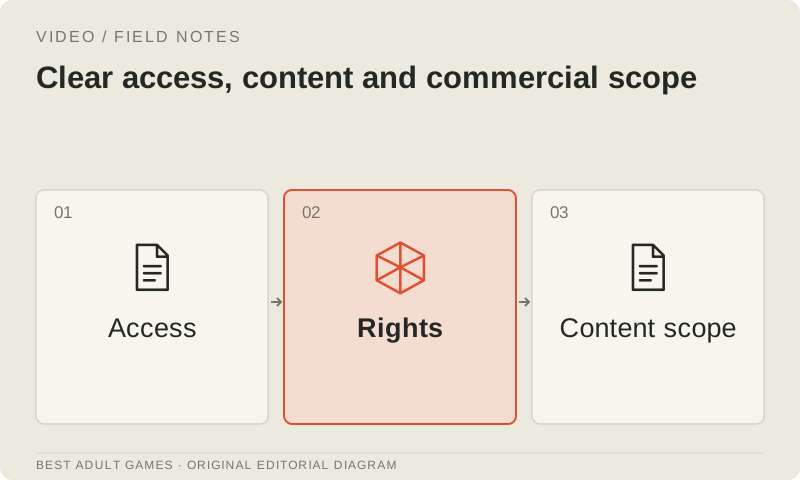
Read the policy for the generation route you will actually use before buying credits or adapting weights. Google, Runway, Adobe, Luma, Vidu and Lightricks restrict explicit material in the policies covered by this catalog. Lightricks’ policy also covers on-premises products. Where a policy is marked unverified, permission remains unresolved; obtain a clear answer for the intended asset before committing to the route. Do not try to work around a refusal, filter or regional limitation.
Check where you may distribute outputs as well as where you may run the model. MiniMax H3 and HunyuanVideo 1.5 have significant territorial license conditions that need to be checked against the release plan. Consumer plans can also differ: Pika’s listed commercial-license tiers and its separate advertising-authorization clause both matter to a promotional trailer. Clear the source art, voice and performer permissions too. A generator subscription does not transfer rights in someone else’s character, portrait or performance.
Run a small controlled comparison
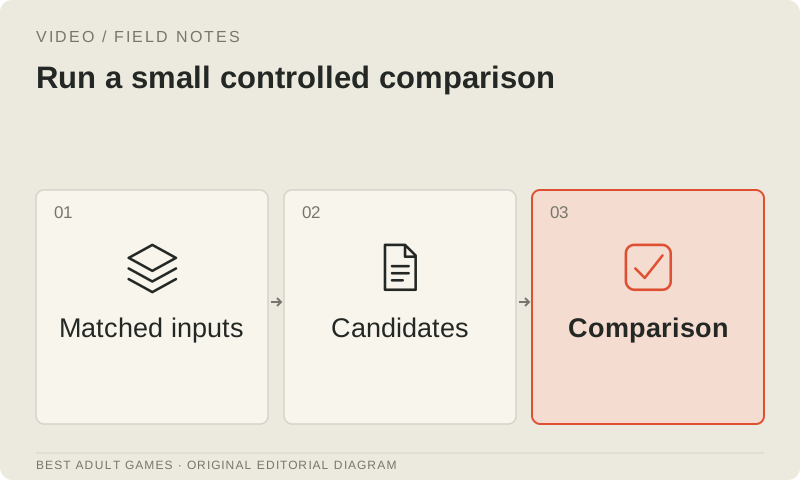
Build a small trial pack from approved non-explicit art. Include a character close-up, restrained movement, a prop interaction, an environmental shot and your most important delivery case, such as a loop or dialogue moment. Keep source inputs, shot briefs and output dimensions consistent wherever the models allow. Generate several takes so one lucky result cannot decide the comparison, and record model IDs, settings and seeds when available.
Review face and costume continuity, intended action, camera behavior, background stability, temporal artifacts and sound separately. For a character-critical take, a changed identity detail is grounds for rejection even if the rest looks impressive. Ask your editor to estimate repair time before choosing a winner. Keep rejected takes with short reasons until the decision is made. Recurring failures can reveal whether the task suits the model or whether the starting art and instructions need work.
Budget approved seconds and preserve the exit
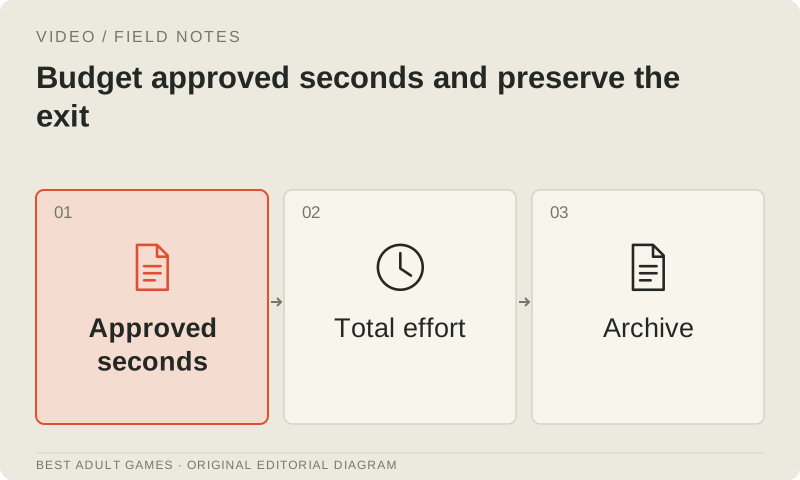
Price the footage you can accept. Add generation charges, rented or owned compute, retries, human review and finishing, then divide the total by the duration of accepted footage. A cheap generated second can become an expensive delivered second after repairs. Include queue time and failed jobs in the schedule. Draft at a supported lower-cost setting when it can settle the creative question, then check that the final setting preserves the approved look before producing the whole batch.
Save masters, source references and an asset manifest outside the provider. Monitor the exact endpoint rather than relying on an old model announcement: OpenAI shut down its Videos API and the Sora 2 and Sora 2 Pro API models on September 24, 2026. A saved export may remain usable under its original terms, but an archived guide cannot bring an endpoint back. Keep a tested alternative for important production roles, and revisit the catalog when a provider changes access, licensing or a major model version.
Key decisions
- Start with the asset brief, match the documented controls and check the exact endpoint.
- Tiers tell you what to investigate first; they do not report an independent benchmark.
- Clear content eligibility, commercial rights and output territories separately.
- Budget per accepted second, including retries, review and finishing.
- Save masters, references and manifests outside the provider so endpoint changes do not erase the pipeline.
External model communities and publishing sites may contain explicit material. Source links open in a new tab; this guide does not load their previews.
Sources & further reading +
- Google video model selection ↗
- Runway model catalog and endpoint IDs ↗
- Official Wan 2.2 repository ↗
- Lightricks acceptable use policy, March 2026 ↗
- MiniMax H3 community license and AUP ↗
- HunyuanVideo 1.5 community license ↗
- Pika plans and commercial licenses ↗
- Pika acceptable use policy ↗
- OpenAI Sora 2 and Videos API shutdown notice ↗
- Google generative AI prohibited use policy ↗
- Runway usage policy ↗
- Adobe generative AI user guidelines ↗
- Luma content moderation policy ↗
- Vidu input and output content moderation ↗
Last checked 5 October 2026.